
The New Rules of B2B Card Processing
Level 3 and Winning in the CEDP Era
by Starr Hodel, VP of Business Development
Stop. Read This First.
You may think you already offer Level 3. You may have merchants telling you they're already optimized. Or, you might be reading this thinking, ‘What the heck is CEDP or Level 3?’ If any of those apply, stop and read this thoroughly.
If you're selling in B2B right now, you've probably heard this from a business owner: “We already have Level 3.” Five years ago, that statement was enough. Today, it means almost nothing.
Here's the current reality:
Level 3 is no longer a feature, it's a performance outcome.
With Visa's Commercial Enhanced Data Program (CEDP) tightening expectations around data quality and consistency, merchants who think they're optimized are often leaving meaningful money on the table.
That’s exactly where you win.
This playbook gives you what you need:
How to understand what's changed
How to diagnose problems quickly
How to set the right expectations
How to position PayBright as the solution
Why This is a Massive Sales Opportunity
This is one of the most misunderstood areas in payments today. And, every experienced agent knows: where there is confusion, there is opportunity.
We're in the middle of a rare industry shift, like EMV in 2012, or cash discount and dual pricing in 2019–2020. The difference this time? With EMV, merchants knew they needed it. Signs went up. Deadlines were public. With CEDP, merchants don't even know it exists. They think they're fine. They're not.
The agents who understand this early will win deals, win trust, and build massive portfolios. The ones who don't will be playing catch-up while their competition has already closed the business.
Will you be the one educating them, or the one losing merchants to someone else who already did?
Quick Refresher: B2B Payment Levels
B2B payments are transactions where businesses accept cards from other businesses, often using corporate or purchasing cards. These transactions have unique interchange rules that create both risk and opportunity.
Level 1: Standard Processing (Highest Cost)
Basic transaction data only: card number, amount, date
Highest interchange rates for commercial cards
The merchant is leaving money on the table
Level 2: Phased Out (Eliminated April 2026)
Level 2 was an enhanced-data tier that sat between Level 1 and Level 3, allowing merchants to capture moderate savings by passing fields like sales tax, customer code, and invoice number. Visa eliminated the Level 2 pricing benefit in April 2026.
This is critical to understand: with Level 2 gone, Level 3 isn't just better, it's the only way to access optimized commercial card pricing. There is no middle ground. A merchant who used to pay 2.20% under Level 2 could likely have been under 2% with Level 3, but if they fail to qualify for Level 3 today, they may now find themselves at 3%+ on Level 1.
Level 3: Full Optimization (Lowest Cost)
Adds full line-item detail: SKU, quantity, unit price
Adds freight, duty, and tax breakdowns
Adds product descriptors and additional transaction data
Lowest interchange for commercial cards, when done correctly
Key insight: “Level 3” isn't a feature. It's a qualification outcome based on data quality.
The Real Pricing Impact
Here's why this matters in real numbers:
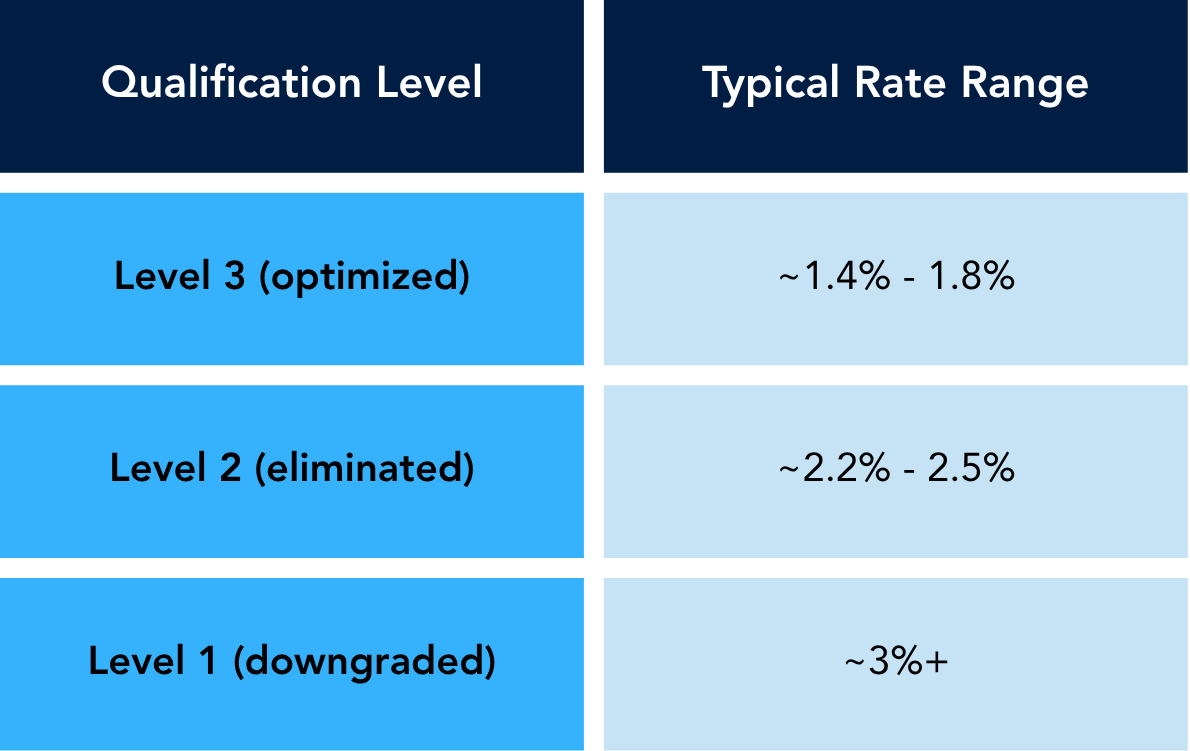
The gap between Level 3 and a downgraded transaction can be 1.5% or more on every transaction. For a B2B merchant processing $200,000/month in commercial card volume, that's:
$3,000/month in unnecessary fees …$36,000/year walking out the door.
And, agents can often price into that savings, increasing deal profitability. This is like overpaying your taxes because your accountant filed incorrectly. The savings were available, the merchant just didn't access them. That's exactly what's happening with the majority of B2B merchants today.
The Big Shift: From Eligibility to Validation
Old World
Submit Level 2 or Level 3 fields → qualify → get better rates
Dummy data worked, that is, placeholder values like SKU “1234” on every line item, generic descriptions like “Product,” or repeated fake values that didn't reflect what was actually sold
Sending “something” was enough, like triggering the tax field by entering $00.01 …no longer!
New World (CEDP)
Submit complete, accurate, consistent data → qualify
Submit incomplete or inconsistent data → downgrade
Data has to look real, be consistent, and make sense
The mindset shift: It's not what you send, it's how well you send it.
What is Visa’s CEDP? (In Plain English)
CEDP, the Commercial Enhanced Data Program, is Visa's way of enforcing discipline around commercial card data. They're essentially saying:
“If you want access to lower interchange on commercial cards, prove your data is reliable.”
What Visa evaluates:
Field completeness
Field accuracy
Consistency across transactions
Merchant category alignment
Critical: A merchant must be enrolled in CEDP to qualify for Level 3 pricing. If they're not enrolled, it doesn't matter if they send perfect data, they will not receive Level 3 rates. With PayBright, you can enroll any merchant in CEDP simply by emailing in the request.
What This Means for Your Merchants
1. “We Have Level 3” ≠ “We're Optimized”
Most merchants:
Assume they're set up correctly
Have never seen a downgrade report
Don't know their qualification percentage
Are not enrolled in CEDP
Translation: there is almost always opportunity.
2. Downgrades Are the Silent Profit Killer
If a transaction misses required fields, has inconsistent tax data, fails to reconcile at the line-item level, or comes from a merchant not enrolled in CEDP — it gets downgraded, often without the merchant ever realizing it.
3. Savings Are Real, But They're Earned Now
Level 3 can still deliver 20–80+ basis points in savings (depending on vertical and card type), but only if data is clean, the merchant is enrolled in CEDP, systems are aligned, and processes are consistent.
Where Most Setups Break (Your Discovery Roadmap)
This is where you'll find the leaks:
POS / ERP Disconnect
Data isn't being passed correctly from the ERP to the gateway. Integrations are partial, outdated, or never validated.
Manual Entry Errors
Staff skipping required fields. Inconsistent invoice formatting. Missing or incorrect tax data.
Gateway Limitations
Not all gateways truly support Level 3. Some claim to but silently drop required fields.
No CEDP Enrollment
The merchant has never been enrolled or never completed verification. Data is being sent, but rates aren't being captured. This is the most common miss, and the most impactful fix.
No Monitoring or Reporting
No visibility into qualification rates. No reporting on downgrades. No accountability loop.
The ERP & Integration Advantage (Your Differentiator)
One of the biggest reasons B2B merchants fail to qualify for Level 3 is a broken or missing connection between their ERP system and their payment gateway.
Through PayBright we can connect to most major ERP systems, enabling proper data flow and Level 3 optimization in cases where it previously wasn't possible, or support Level 3 directly through our gateway.
This is a major competitive advantage. Many ISO and agents cannot do this. PayBright can.
When you're talking to a mid-size B2B merchant running NetSuite, Microsoft Dynamics, Sage, SAP, Acumatica, Epicor, or QuickBooks Enterprise who has been told they “have Level 3”, this is your differentiator. You can actually fix it.
Bonus tool for you: PayBright will perform free statement reviews on any prospect, and we specifically look for Level 3 optimization opportunities, the kind most agents miss. Send us a statement and let us help you find the leaks!
The Sales Play: How to Position This
Stop leading with rates. Start leading with performance gaps.
Step 1: Open with Curiosity (Not Criticism)
Try this opener:
“Many B2B companies think they're optimized for corporate cards, but with recent Visa changes, many are only qualifying 60–70% of the time, and some aren't even enrolled in the program required to access Level 3 rates. Do you know where you fall?”
Step 2: Ask These 4 Questions
1. What percentage of your transactions qualify for Level 3?
2. Do you have visibility into your downgrade rates?
3. Is your data being passed automatically through your ERP/POS, or entered manually?
4. When was the last time your setup was reviewed, and are you enrolled in CEDP? Most prospects won't have clear answers. That's your opening to be a consultant, educate, and win.
Step 3: Reframe the Problem
Not: “Your rates are too high.”
Instead: “You may not be qualifying for the rates you're supposed to be getting, and there may be a simple enrollment step you've missed entirely.”
Step 4: Set Expectations Early
Be honest, win trust:
Not every transaction will qualify
Data discipline is required on an ongoing basis
Systems may need adjustment
CEDP enrollment is a prerequisite, not an optional add-on
This is how you avoid churn later, by not overselling on day one.
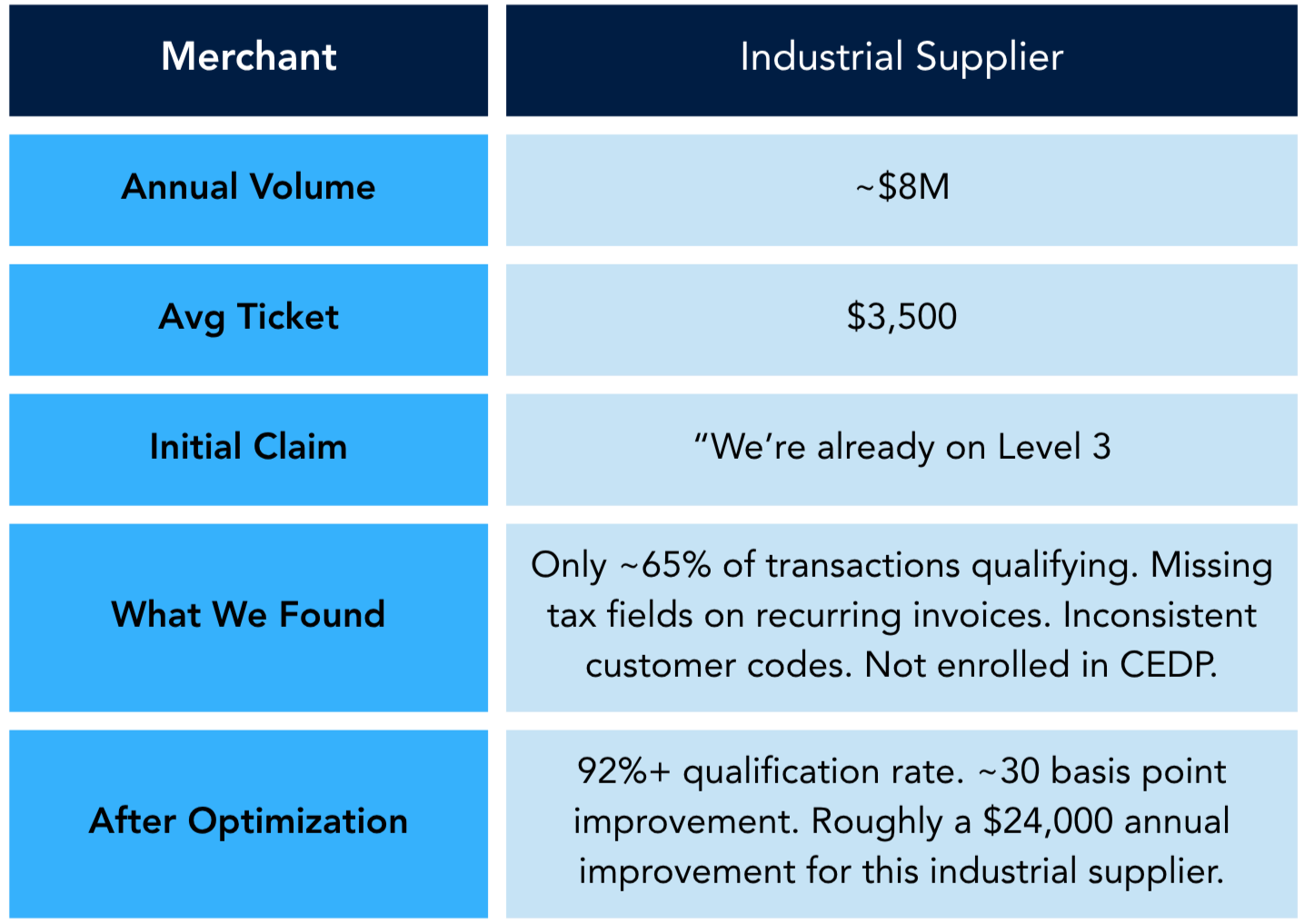
Real-World Case Study
How PayBright Supports You in This Environment
You own the merchant relationship. We back you up with the tools to win it, and keep it.
Here's how we partner with you:
Free statement reviews, we'll analyze any prospect statement and flag Level 3 leaks before your sales conversation
CEDP enrollment for any merchant, just email us the request
POS / ERP / gateway compatibility assessments to validate data flow
Transaction-level diagnostics to allow agents to monitor rates for ongoing optimization
You drive the conversation, set merchant expectations, and own the outcome. PayBright gives you the back-end firepower most ISOs simply can't match.
Setting the Right Merchant Expectations
This is critical for long-term retention.
What to Say
“There's opportunity, but we need to validate your data flow first.”
“Savings depend on consistency, not just setup.”
“CEDP enrollment is step one, without it, optimization is impossible.”
“We'll help you improve over time, not just on day one.”
What NOT to Say
“We'll save you X% guaranteed.”
“You're already optimized.”
“This is turnkey, plug-and-play.”
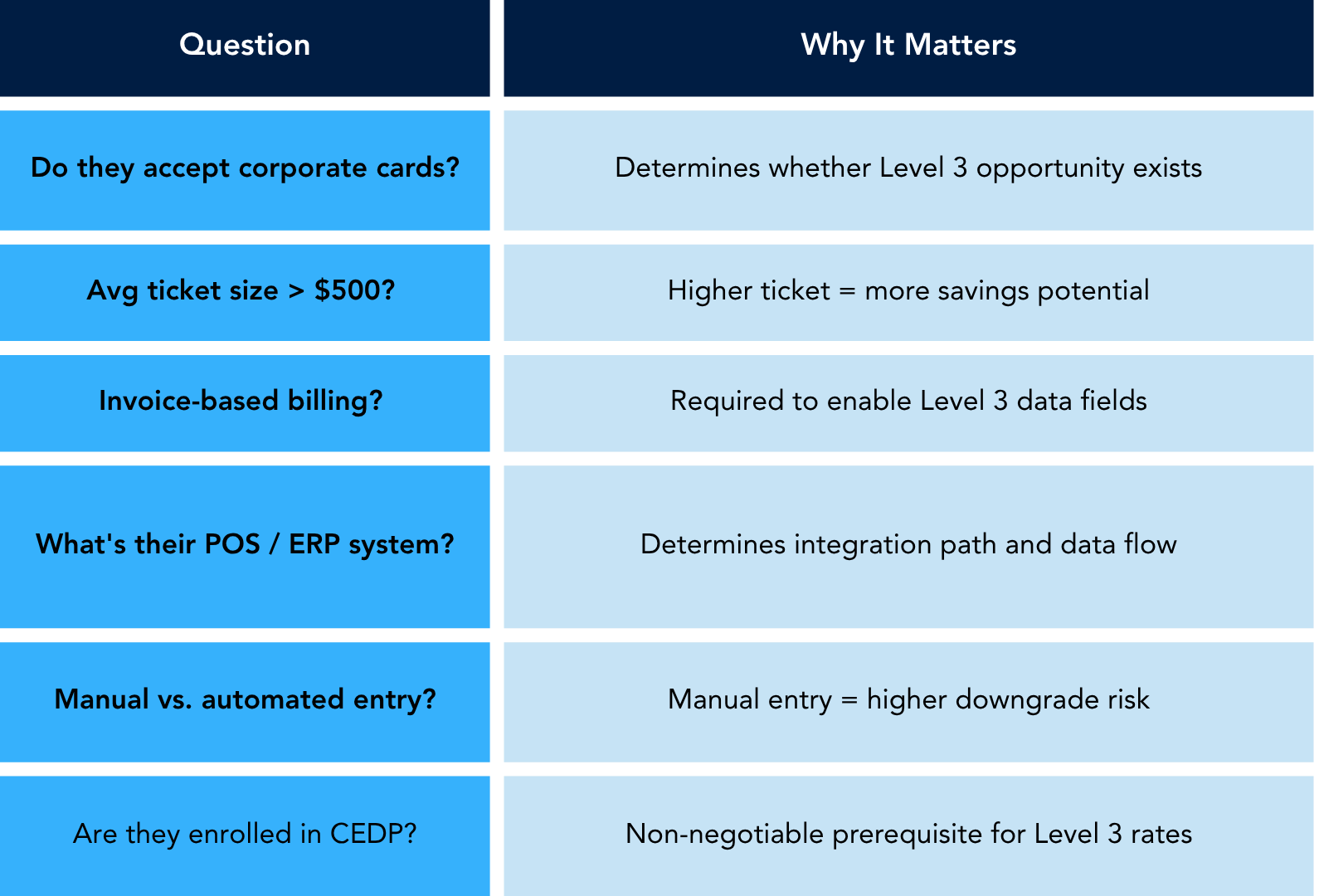
Ideal Merchant Profile
Look for:
B2B or B2G businesses
Average ticket > $500
Invoice-based transactions
Corporate or purchasing card volume
Running an ERP system such as NetSuite, Microsoft Dynamics 365, Sage (Intacct, 100, X3), SAP Business One, Acumatica, Epicor, Infor, Oracle, or QuickBooks Enterprise
Strong verticals:
Wholesale and distribution
Manufacturing
Construction and building supply
• Professional services billing corporate clients
Medical, dental, and veterinary supply
IT services and managed service providers (MSPs)
Equipment rental and leasing
Fleet, transportation, and logistics
Industrial and janitorial supply
Commercial printing
Agricultural and farm supply
Government contractors
Electrical, plumbing, and HVAC supply
Commercial auto parts
Quick Qualification Checklist
The Close: Turning Insight into Action
If you've uncovered gaps, position the next step clearly:
“What we'd like to do is review your current setup, identify where transactions may be downgrading, confirm whether you're enrolled in CEDP, and show you exactly where the opportunity is, before making any changes. Low pressure, high value.”
Bottom Line
Optimization is still powerful, but it has evolved drastically. Under CEDP:
Optimization is earned, not assumed
CEDP enrollment is the entry ticket
Data quality is everything
Most merchants are underperforming without realizing it
Your Advantage
If you can diagnose gaps, educate clearly, set honest expectations, enroll merchants in CEDP, and deliver measurable improvements, you're no longer just selling processing. You're delivering profit recovery.
If you need help reviewing a deal or walking through a merchant's setup, lean on the PayBright team. We're here to help you turn:
“We already have Level 3.” → “We're optimized, and we can prove it.”